
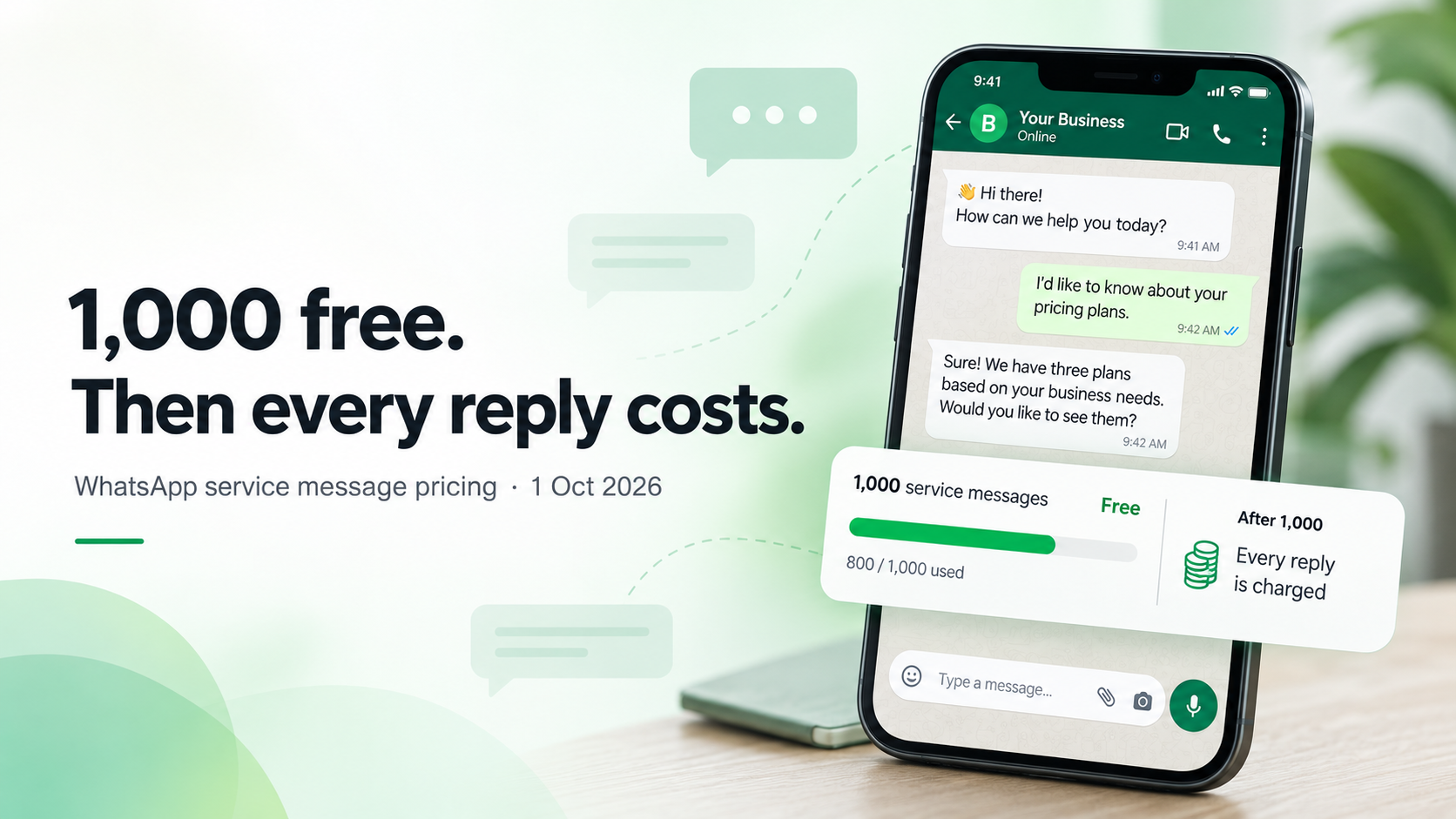
Meta will start charging for WhatsApp service messages on 1 October 2026. Every business phone number still gets 1,000 free service messages each month. From the 1,001st message, you pay per delivery — and if you have no payment method in Billing Hub, Meta will stop delivering those messages entirely.
If your team uses WhatsApp for support, sales follow-ups, or automated replies inside the 24-hour window, this update matters. Here is a clear breakdown of what is launching, how billing works, and how to avoid disruption.
What is launching on 1 October 2026?
As announced on 1 July 2026, Meta will charge for service messages on a per-message basis from 1 October 2026 at 12:00 am in your WhatsApp Business Account (WABA) timezone.
As announced on 1 September 2026, Meta is also introducing a free monthly tier:
| Rule | Detail |
|---|---|
| Free allowance | 1,000 service messages per business phone number, per month |
| When charging starts | From the 1,001st delivered service message that month |
| Rollover | No — unused free messages do not carry over |
| Reset | Monthly, per phone number, at the start of the next month |
Important: There is no change to when a service message can be sent. Service messages can still only be sent inside an open 24-hour customer service window, which opens and resets each time a customer messages you.
Official pricing details: Meta WhatsApp Business Platform pricing.
What counts as a service message?
On the WhatsApp Business Platform, service messages are the free-form (non-template) replies you send inside an open customer service window — for example:
- Agent text replies
- Images, documents, audio, and other non-template media
- Bot or AI replies that are not approved templates
These messages have been free for most businesses since 1 November 2024. From 1 October 2026, they become a billable category after the monthly free tier.
Template messages remain separate:
| Message type | Before 1 Oct 2026 | From 1 Oct 2026 |
|---|---|---|
| Service (non-template, inside 24h window) | Free | First 1,000 free per phone number / month, then charged |
| Utility templates inside the 24h window | Free (since 1 Jul 2025) | Charged |
| Utility templates outside the window | Charged | Charged (unchanged) |
| Marketing templates | Charged | Charged (unchanged) |
| Authentication templates | Charged | Charged (unchanged) |
How much will service messages cost?
Meta has confirmed that service message rates will match utility and authentication rates by market. Charges are based on the country calling code of the recipient’s WhatsApp number, not where your business is based.
Key billing dynamics:
- Per delivered message — you are charged when the service message is delivered.
- Same market rate as utility / authentication — service pricing follows that market’s rate card.
- No volume tiers for service — unlike utility and authentication templates, service messages do not unlock cheaper tiers at higher volume.
- Free tier is per phone number — if you run three numbers, each gets its own 1,000 free messages.
Always check Meta’s published rate cards for your billing currency before forecasting costs:
- WhatsApp Business Platform pricing
- Interactive rates on the WhatsApp Business platform pricing page
Rough cost example
Suppose one business phone number sends 3,500 service messages in a month to customers in a market where the utility/authentication rate is ₹0.115 per message:
- First 1,000 → free
- Remaining 2,500 → 2,500 × ₹0.115 = ₹287.50
Scale that across multiple numbers, high-volume bots, or multi-agent inboxes, and the monthly bill becomes material quickly.
Payment method required: do not ignore Billing Hub
Meta’s notice to business managers is unambiguous:
For every business phone number, Meta will only charge as of the 1,001st service message delivered each month. For businesses that do not have a payment method in Billing Hub, Meta will deliver the first 1,000 service messages each month but will not deliver from the 1,001st.
That means:
- With a payment method — messages continue after 1,000; you are billed for the rest.
- Without a payment method — delivery stops at message 1,001 that month. Support threads go silent mid-conversation.
What you should do now
- Open Meta Billing Hub for each business portfolio you manage.
- Add a valid payment method.
- Confirm billing currency, legal entity, and that the right WABAs are linked.
- If you manage multiple clients or subsidiaries, check every WABA — one missing card can disrupt an entire support queue.
- Set an internal reminder before 1 October 2026 to re-verify that payment methods are active and not expired.
Partners and agencies: treat this as a client readiness checklist. Continuity of service messages depends on Billing Hub being set up correctly.
Related October 2026 pricing updates (same launch date)
Service monetisation is not the only change landing on 1 October 2026. Meta’s rate-card update also includes:
1. Utility templates inside the customer service window become chargeable
Since 1 July 2025, utility templates sent inside an open 24-hour window have been free. From 1 October 2026, those responses are charged at utility rates.
You can still send utility templates outside the window (to proactively update customers). That behaviour does not change — only the “free inside the window” treatment ends.
2. Quarterly rate card updates
Selected markets see marketing, utility, and authentication rate changes. Several markets also move from regional “Rest of …” pricing to standalone market rates, with market-specific volume tiers for utility and authentication.
3. Authentication-international expansion
Additional markets gain authentication-international rates. Eligibility and charging rules are expanding toward more markets over September–October 2026. Review Meta’s authentication-international documentation if you send OTPs at scale.
What does not change?
It is easy to overreact. These rules stay the same:
- Service messages still require an open 24-hour customer service window.
- That window still opens and resets when the customer messages you.
- Marketing and authentication template categories remain separate, billable products.
- Free entry point (FEP) windows from Click-to-WhatsApp ads / Page CTAs still provide a 72-hour free messaging period when the documented conditions are met.
- Pricing continues to follow Meta’s calendar (updates on quarter starts, with advance notice).
Who is most affected?
| Business profile | Likely impact |
|---|---|
| Low-volume support (under ~1,000 service replies / number / month) | Mostly covered by the free tier |
| Multi-agent helpdesks | Free tier used quickly; need payment method + budget |
| Chatbots / AI auto-replies inside the window | High message counts; linear cost after 1,000 |
| Order updates via utility templates inside the window | Newly chargeable from 1 Oct 2026 |
| Agencies managing many WABAs | Highest operational risk if clients lack Billing Hub cards |
How to prepare before 1 October 2026
Use this practical checklist:
- Add Billing Hub payment methods for every WABA that sends service traffic.
- Estimate monthly service volume per phone number (agents + bots combined).
- Model cost using Meta’s utility/authentication rate for your top destination markets × messages above 1,000.
- Audit bot verbosity — fewer, clearer replies reduce billable deliveries after the free tier.
- Review utility template usage inside the window — those will also be charged.
- Separate marketing / utility / authentication strategy so support traffic is not mixed into expensive marketing templates.
- Monitor pricing analytics in Meta and your BSP dashboard after launch so you catch spikes early.
- Brief your support and finance teams so nobody is surprised by a blocked delivery or a new line item on the invoice.
FAQ
Are the first 1,000 service messages really free?
Yes. Each business phone number receives 1,000 free service messages per month. Meta charges from the 1,001st delivered service message. Unused free messages do not roll over.
Will Meta stop my messages if I have no card on file?
Yes, after the free tier. Without a payment method in Billing Hub, Meta will deliver the first 1,000 service messages that month and will not deliver from the 1,001st onward.
Do volume discounts apply to service messages?
No. Service rates align with utility/authentication list rates by market, but Meta has not applied volume tiers to service messages the way it does for utility and authentication templates.
Can I still reply freely inside the 24-hour window?
You can still reply inside the window. From 1 October 2026, those service replies are metered after the free tier. The window rules themselves are unchanged.
Is this the same as the old “1,000 free service conversations”?
No. That belonged to the deprecated conversation-based pricing model. This is a per-message free tier under the current per-message pricing model, counted per business phone number each month.
Where should I verify official rates?
Use Meta’s documentation and rate cards:
Bottom line
From 1 October 2026, WhatsApp service messaging stops being unlimited and free. You get a predictable cushion — 1,000 free service messages per phone number per month — then pay per delivery at market utility/authentication rates. Utility templates inside the 24-hour window also become chargeable on the same date.
The single most urgent action is operational, not technical: add a payment method in Billing Hub so delivery does not stop at message 1,001. Then measure your volume, tighten bot and agent reply patterns, and budget for the markets you message most.
If you run WhatsApp support at scale, treat September as your readiness month — payment methods, volume forecasts, and internal playbooks — so 1 October is a billing change, not a customer experience outage.
This article summarises Meta’s published WhatsApp Business Platform pricing updates as of September 2026. Rates and policies can change; always confirm against Meta’s official pricing documentation before making commercial decisions.

Leave a Reply
You must be logged in to post a comment.